

As summer ambient temperatures rise, cooling pressure on data centers and network rooms increases significantly. Improper airflow inside cabinets can create hot spots, leading to equipment throttling or failure. Based on standard cabinet design parameters, this article provides five actionable cooling measures to improve the operational stability of server racks and network cabinets.
The front door directly affects how cold air reaches equipment.
Glass door with side ventilation strips: Provides equipment visibility and basic dust protection. The side strips allow some airflow. Suitable for low‑density deployments or security‑sensitive areas.
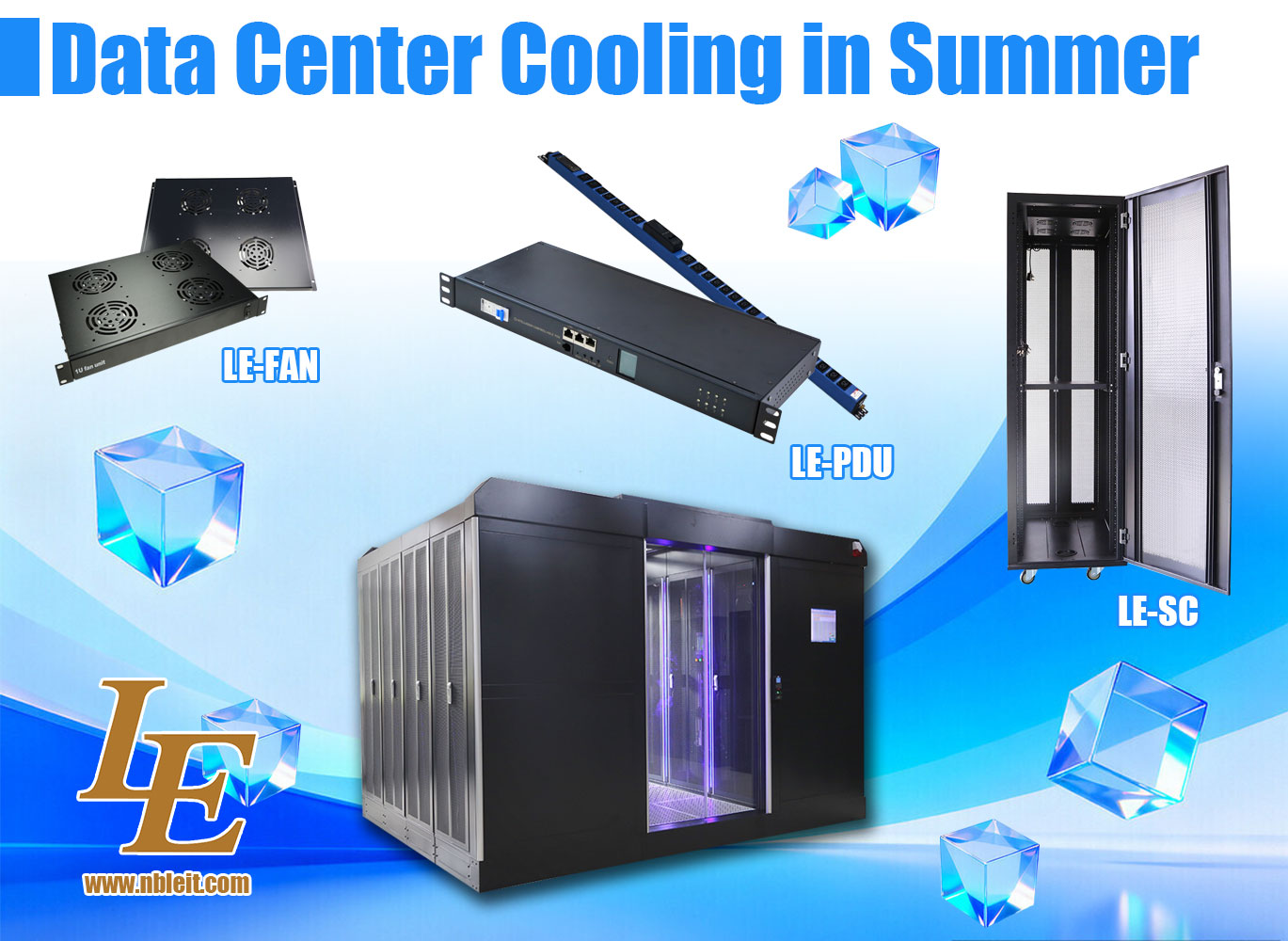
Mesh door: For example, our SC series arc‑shaped vented front door uses hexagonal mesh with an open area of 75%. For high‑density deployments (cabinet power >5kW) or hot summer months, a mesh door significantly lowers equipment intake temperatures.
Selection tip: If the cabinet mainly holds low‑power devices (switches, patch panels), a glass door is sufficient. For multiple high‑power servers or GPUs, choose a mesh door.
Tangled patch cables block front and rear vertical airflow channels, preventing cold air from reaching equipment fronts and hot air from exhausting.
Method: Install vertical cable managers on both sides of the cabinet. A typical width is 6 inches (approx. 150mm) with a cover. Organize patch cords neatly to avoid blocking mesh door openings.
For wide cabinets: For 800mm‑wide cabinets, dedicated vertical cable managers provide more routing space.
Effect: After cleaning, intake temperature can drop by 3‑5°C (depending on cable density).
For applications with high heat loads and no direct precision air conditioning, active exhaust at the top is the most direct supplemental cooling.
Configuration: Most cabinets have pre‑cut mounting holes for 120mm fans, accommodating 1‑4 axial fans (110V or 220V). Fan units should have an independent switch for seasonal or load‑based manual/automatic operation.
Outdoor cabinets: For LE-DA series outdoor cabinets, active cooling is essential in summer to maintain internal temperatures within equipment limits (typical operating range -40°C to +50°C).
Note: Fans should exhaust toward the rear or top of the cabinet, avoiding conflict with room air conditioning flow.
When ambient temperatures exceed 40°C for long periods, or equipment power density is very high without room‑level cooling, standard fans may be insufficient. An integrated industrial air‑conditioned cabinet is the solution.
Cooling capacity: Typically 1kW to 5kW, matched to total equipment power (recommend 1.2‑1.5x cooling capacity per kW of equipment power).
Temperature control: Even when outside temperature reaches 55°C, internal temperature stays in the safe range of 25‑35°C.
Typical applications: Outdoor telecom base stations, desert solar farms, oilfield monitoring stations, factory floors without central HVAC.
The root cause of many cooling problems is excessive power density. Real‑time current monitoring allows intervention before overload occurs.
Metering accuracy: Class 1 accuracy, current resolution 0.01A – monitors voltage, current, power, energy.
Alarm function: Set overload thresholds (e.g., 10A, 16A, 32A). When current approaches the threshold, an alarm alerts operations to adjust load or add cooling.
Hot‑swappable design: The metering module is hot‑swappable – replace without powering down equipment, ensuring business continuity.
Value: Power data from the intelligent PDU can also help calculate actual cabinet heat load, providing a basis for sizing air‑conditioned cabinets or fans.
By optimizing server rack and network cabinet airflow and power monitoring, you can lower equipment temperatures, extend service life, and reduce unplanned downtime. For detailed specifications on mesh doors, vertical cable managers, fan units, air‑conditioned cabinets, or intelligent PDUs, please contact us for technical data sheets.

Tel: +86 13486085502
Fax: +86-574-81880564
E-mail: leo@nbleit.com
Address: East District, Guanhaiwei Industrial Zone, Cixi City, Zhejiang Province, China
Copyright © 2018 Latitude All Rights Reserved